With the arrival of good weather, it is common to remember the pool we have at home, which has lacked maintenance during the winter.
If this is your case, let us tell you that everything has a solution. That is why, in order to learn how to clean a pool so you can enjoy it during all the hot months, we are going to detail various tricks and a guide so you can leave the pool cleaner than ever and prevent the accumulation of different external agents.
So join us to learn how to clean a pool.
What is needed to clean a pool?
To clean a pool, it will be necessary to know its condition; for this, we will perform a visual check and determine if it is plagued with dirt, if the water is green, if there are bugs, or if the water is cloudy.
To examine it more thoroughly, we will use test strips or pH tests to determine in more depth the current state of the pool water.
🗒️ In order to start cleaning the pool, we will need:
Chlorine/bromine tablets
Flocculant (in case the water is green)
Vacuum/pool cleaner (in case there is dirt on the bottom or walls)
pH test (or reactive analysis strips)
Butterfly net (to clean surface dirt)
Brush with extendable pole
How to Successfully Clean a Pool. Step by Step
Once we have the necessary products for cleaning the pool, we should start putting into practice the following steps that we detail for you. We recommend reading this guide and then putting it into practice.
1. Brush the floor and walls.
Once we get to work, we should start by removing the dirt embedded in the pool using a telescopic pole brush; this way, the dirt will float in the pool water and later we can remove it by filtering the water.
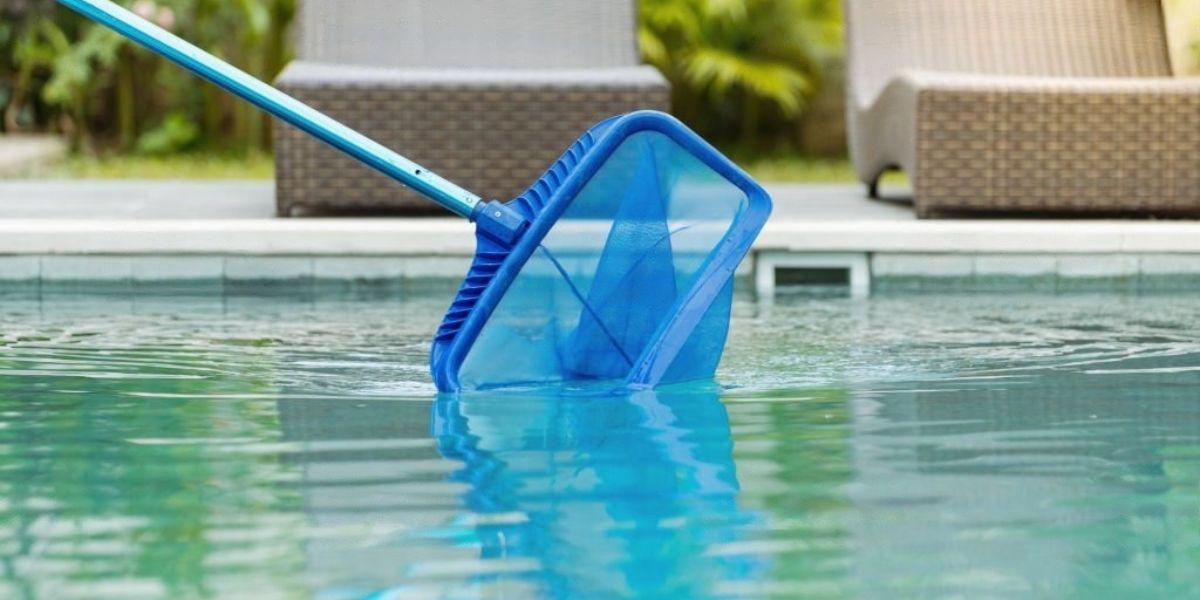
After brushing the pool, we should manually remove the surface dirt that is visible, such as leaves, branches, small insects, and other debris that may appear in our pool, using a skimmer.
In addition, if your pool has water collection channels, take a look at their condition, as much of the dirt found in the filter comes from these channels. Therefore, it will be advisable to carry out a cleaning.
2. Vacuum the bottom of the pool and filter the water
The difficult and tedious part of brushing is over, so now it's time to vacuum the bottom of the pool and filter the water to make it crystal clear and free of microorganisms and microbes in the pool.
If you have an automatic pool cleaner, it will be easier since we just need to keep the filtration system running, although if we have a manual cleaner, we will have to do the cleaning work with our own hands. The difficulty and time will depend on the size of the pool we have, as if it is a small one, it will be easy to remove all the dirt present.
It is important to note that when we activate the pool filtration system, we must have the filters installed, add the necessary chlorine, as well as flocculant if needed. This will ensure maximum cleaning efficiency.
3. Clean the filters and the pool vacuum.
After 5 hours of cleaning and filtering, we should clean the filters and the pool vacuum to continue ensuring crystal clear water and make the most of the resources.
Depending on the capabilities of the pool, whether it is chlorine or saltwater, and the different systems it has, it will be necessary to clean more or fewer elements when we need to do it periodically, as well as to purchase the corresponding replacements for our pool.
If we deem it necessary or if the pH of the water we analyzed earlier was at the extremes of the scale, we may need to perform a pH test to determine if we need to add more chlorine, whether the pH is positive or negative.
Check out our blog about How to Raise the pH of Water
4. Check that the pool is in the condition we want.
In order to complete the cleaning of the pool, we must check the pH values, conduct a visual inspection of the water's condition, ensure that the filters do not contain any dirt to filter at maximum capacity, and that the levels of the product we use are within the optimal values.
Once these steps have been completed and especially the last one has been reviewed carefully, we can conclude that we have learned how to clean a pool. Remember to carry out this type of cleaning periodically as well as a weekly maintenance for prevention. If you don't have a pool cleaner to do the cleaning tasks for you, this is your chance to get one!
Pool cleaning tips for beginners
For those beginners in the world of pools, the magnitude of products and techniques that exist can be quite a revelation. Discover below a series of tips that will help you in cleaning the pool if you are a beginner.
Visually check for any damage in the pool itself (broken tiles, water leaks, broken lights).
Do not use soaps or detergents for cleaning; in the case of experts, a little bleach can be used in combination with chlorine.
Every 48/72 hours, check the condition of the pool filters for optimal filtration as well as the products for water treatment.
At least once a week, perform maintenance on the bottom and walls to prevent algae and other problems.