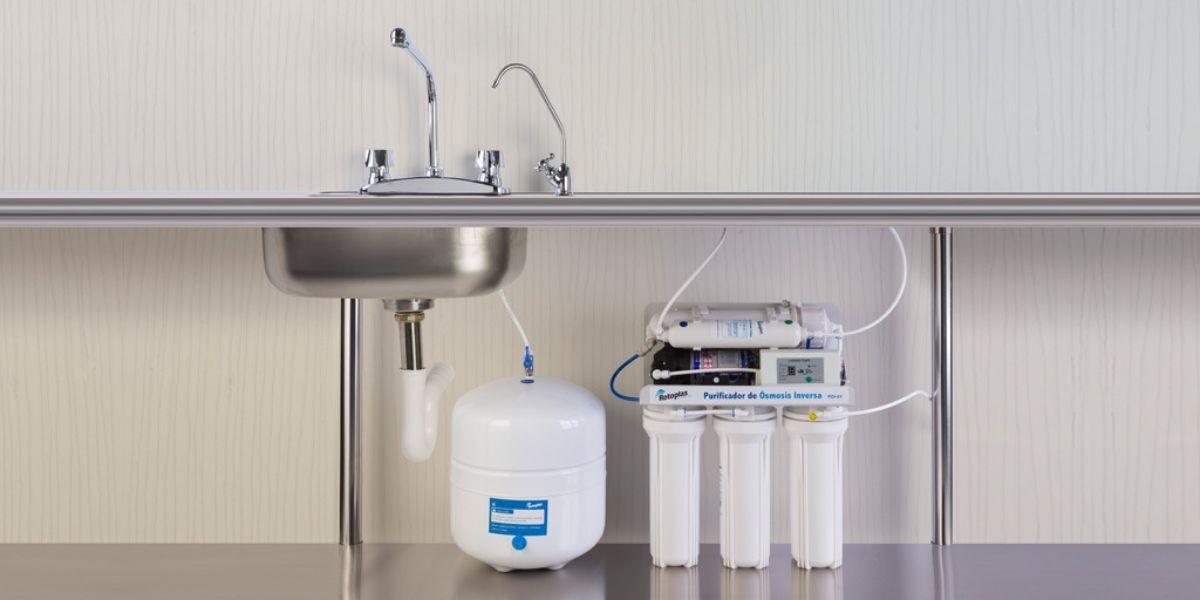
If the water in your home is not good or does not fully satisfy you, installing a reverse osmosis system will help you enjoy quality water for drinking and cooking. You probably know that a reverse osmosis system is a device that purifies water so that it can be potable, but… do you know how the process works?
What is reverse osmosis?
Reverse osmosis is a physical-chemical treatment inspired by a natural process that allows for the purification of water to obtain mineral-type water. This purification is made possible by a system of filters and osmotic pressure that reduce the contaminants present in the water before treatment, such as bacteria, viruses, chemical pollutants, etc., resulting in drinking water of excellent quality.
Reverse osmosis systems carry out this treatment; they are compact and small purifying units that are installed under the kitchen sink, along with an additional faucet, the reverse osmosis kitchen faucet. The effectiveness of the filtration system is 93-97%.
Which reverse osmosis system is the most recommended?
Frequently, we find it difficult to strike a balance between quality and price. At Groupsumi, we believe that in the case of osmosis equipment, the quality of the equipment must be highly considered, as it will be responsible for providing us with the water that enters our bodies, and health is not something to be taken lightly. For this reason, we only work with major brands that manufacture high-performance equipment. Our prices are very competitive so that the benefits of osmosis water can reach all households.
Discover here the reverse osmosis systems
When purchasing a system, you should consider certain aspects, such as:
Standard or compact: if you prioritize an economical price, standard units will be a good option. On the other hand, if you prefer a more discreet unit, we recommend taking a look at the compact ones.
With pump or without: generally, units come without a pump, as it is not necessary if the household pressure is adequate. The use of a pump is recommended in buildings with low pressure.
Production-rejection value: the water that comes out of the unit, once it has gone through the process, is of 2 types: reject water not suitable for consumption and drinking water. What we should look for in a unit is efficiency. For example, the Circle 160 unit from ATH only rejects 2 liters for every liter produced.
How often should the filters be changed?
First of all, we must be clear that performing maintenance and changing filters involves replacing the cartridges of the system (the filters, the membrane, and the post-filter). The time elapsed between one maintenance and another depends on several factors, such as the quality of the equipment and the quality of the water in the area where it is installed. Generally, the filters are changed every year and the membrane every 2-3 years. On the other hand, it is important to carry out disinfection of the equipment and the storage tank.
If you have any questions, contact us and we will respond quickly!