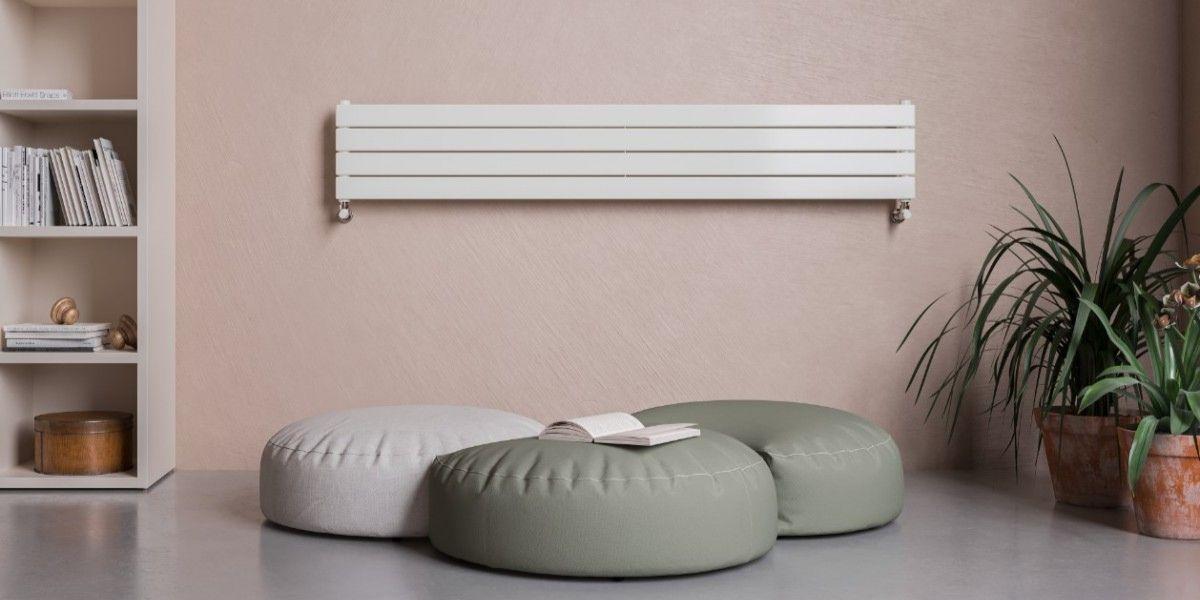
Calculate the elements per m2 that you need for your radiator.
When it comes to keeping our home warm and cozy, radiators play a fundamental role. But how can we ensure that we are installing the right amount of radiator elements per square meter to achieve efficient heating?
In this article, we will explore in detail the calculation of radiator elements per m2 and how to optimize this process for optimal comfort in your home.
Why is it important to calculate the elements of a radiator?
Energy efficiency is key in any heating system, and the precise calculation of radiator elements per square meter is essential to achieve it. An insufficient installation could leave cold spots in your home, while oversizing could unnecessarily increase energy consumption. To find the perfect balance, it is essential to understand how to perform the correct calculation.
Factors to consider when calculating the elements per m2
In order to correctly calculate how many elements are needed per square meter (m2) for the different rooms in the home, we must take into account a series of data that we will later apply in our calculations.
Location of our home
This first factor will be of great importance, since depending on where our home is located, it will be colder or warmer during the winter months, and therefore, with lower temperatures, if we were to perform the calculations in the same way throughout the peninsula, these radiators would lose efficiency in the coldest months.
We will take into account the following areas and their respective values in the subsequent calculations:
Zone A: (VALUE = 0.88) Zone B: (VALUE = 0.95) Zone C: (VALUE = 1.04) Zone D: (VALUE = 1.12) Zone E: (VALUE = 1.19)
At GroupSumi, we always recommend that in case of doubt, it's better to exceed the area. This way, if it ends up being slightly more powerful, we can adjust the heating to a lower temperature and thus contribute to energy and economic savings.
Existing insulation
In addition to the location, insulation is a fundamental factor when determining the number of elements per m2 that a radiator should have. Therefore, we should review our aluminum carpentry, wall coverings, windows, as well as any factor that may influence both the entry of cold air and the escape of heat.
Good insulation: Double window and double partition (VALUE = 0.93)
Simple insulation: Single window and double partition or double window and single partition (VALUE = 1)
No insulation: Single window and single partition (VALUE = 1.10)
Steps to Calculate the Radiator Elements per Square Meter (m²)
1. Determine the Dimensions of the Room
To begin with the precise calculation of radiator elements per square meter, it is essential to obtain accurate measurements of the room where you plan to install the heating system. Use a tape measure to measure the length, width, and height of the room in meters.
For example, if we have a room of 20 m² (with a length of 5 meters, a width of 4 meters, and a height of 2.5 meters), the values would be:
Length: 5 meters
Width: 4 meters
Height: 2.5 meters
2. Consider the Insulation
The level of insulation in the room has a significant impact on the amount of heat required to maintain a comfortable temperature. Assess the quality of insulation in the walls, ceilings, and windows.
You should use the previously mentioned value scale, so in the hypothetical case of a home with simple insulation, we will use the value 1.
3. Calculate the Thermal Load
The thermal load refers to the amount of heat needed to maintain the room at a comfortable temperature under specific climatic conditions. You can use the following formula to calculate the thermal load:
Thermal Load = Room Volume × Typical Height × Temperature Difference × Insulation Factor
👉🏼 Where:
Temperature difference: 22 ºC (indoor temperature) – 0 ºC (outdoor temperature) = 22 ºC
Insulation factor: 1.1 (representative value)
Total Thermal Load = Room Area x Height x Temperature Difference x Insulation Factor
Total Thermal Load = 20 m² x 2.5 m (typical height) x 22 ºC x 1.1 = 1210 W
4. Calculation of radiator elements per m2
For this example, let's consider that the selected radiator has a heating capacity of 1500 W.
Radiator Elements per m2 = Total Thermal Load / Heating Capacity of a Radiator Element
Radiator Elements per m2 = 1210 W / 1500 W = 0.807
In this case, you would need approximately 0.807 radiator elements per square meter. Since it is not possible to have a fraction of an element, you would have to round up. Therefore, you would require 1 radiator element for this 20 m² room.